Sea moss (Chondrus crispus, also sold as Irish moss) is a red seaweed, and the honest starting point for a buying guide is that it is a food, not a standardised supplement. Two bottles carrying the same milligram number on the front can deliver very different amounts of the one compound that actually carries risk.
This guide is about how to tell those two bottles apart. It covers what to look for on a label, what a real lab report contains, and which quality signals are meaningful versus which are marketing language. It is informational only and is not medical advice.
Key Takeaways
- Iodine, not the plant weight on the front of the bottle, is the number that decides whether a sea moss product is safe for you.
- Measured iodine in commercial seaweed products spans several orders of magnitude, and labelling is frequently incomplete or inaccurate.
- Seaweed concentrates arsenic, lead and cadmium from its growing water, so a batch specific lab report matters more than a wildcrafted or organic claim.
- Blends that add bladderwrack raise the iodine load and usually hide the per species contribution.
- Anyone with a thyroid condition, on thyroid medication, pregnant or breastfeeding should clear sea moss with a doctor before starting.
What Safe Actually Means for a Sea Moss Product
Safety for a sea moss product breaks into three separate questions that buyers routinely collapse into one. The first is dose: how much iodine a serving actually delivers. The second is contamination: what the seaweed absorbed from the water it grew in. The third is identity: whether the bottle contains the species named on the front, at the amount stated.
None of these are answered by the words natural, organic or wildcrafted. Organic certification governs how something was grown and handled, not how much iodine or arsenic ended up in it. A product can be genuinely organic, genuinely wildcrafted, and still deliver an iodine dose you did not intend to take.

Iodine Is the Number That Matters Most
Iodine is the reason sea moss is worth taking seriously and the reason it deserves caution. The thyroid needs iodine to make thyroid hormone, so the mineral is genuinely essential. The difficulty is that the useful range is narrow at both ends, and seaweed is one of the few foods capable of overshooting it in a single serving.
Measured iodine content in red seaweeds is variable rather than fixed. A study analysing 30 samples of dulse and Irish moss found Irish moss averaging 3.86 milligrams per kilogram of dry weight, with a standard deviation of roughly 1.5, meaning individual samples of the same species diverge substantially[1]. That is variation within one species, before any processing or blending.
Across finished products the spread is far wider. Researchers who analysed 96 commercially available macroalgae products found iodine ranging from 5 to 5,600 micrograms per daily dose in supplements, and concluded that for 54 of the products a single portion or dose would exceed the tolerable upper intake level for iodine[2]. The same study reported that species labelling and iodine declarations were inadequate or inaccurate for several products, which is why a label alone cannot be treated as a dose.
This is a labelling problem as much as a biology problem. A survey of 224 seaweed and seaweed containing products on the UK market found that only 22 of them, about 10 per cent, stated any information about iodine content at all[3]. If a product does not give you iodine in micrograms, you are not choosing a dose, you are accepting whatever the batch happened to contain.

Heavy Metals and Why Sourcing Beats Marketing
Seaweeds are bioaccumulators. They concentrate elements from the surrounding water, which is why they are mineral rich and also why they can carry arsenic, lead and cadmium. A survey of 25 edible seaweeds from five origins found total arsenic highest in the brown seaweeds, ranging from 11 to 162 milligrams per kilogram of dry weight[4].
That figure deserves an honest qualification rather than alarm. The same study found arsenosugars, an organic form, to be the predominant arsenic species in most samples, accounting for up to 99.7 per cent of total arsenic, and calculated that inorganic arsenic intake from the seaweeds studied presented low risk[4]. Total arsenic and toxic arsenic are not the same measurement, and a lab report giving only a total tells you less than one that separates the two.
The risk is not hypothetical at the level of an individual product. A published case report describes a woman who developed worsening hair loss, memory problems, fatigue, nausea and rash over two years, was found to have a urinary arsenic level of 83.6 micrograms per gram of creatinine against a normal below 50, and whose daily kelp supplement measured 8.5 milligrams per kilogram of arsenic. Her symptoms resolved and her arsenic levels became undetectable within weeks of stopping the supplement[5].
That case involved kelp rather than sea moss, and it is a single case rather than a population study, so read it as an illustration of how a contaminated batch reaches a person rather than as a statement about sea moss specifically. The practical lesson generalises: the harvest water and the testing regime decide the contamination profile, and neither is visible from the front of the bottle. For what the arsenic, lead and cadmium figures on a batch report actually mean, see our breakdown of sea moss heavy metal testing.
Reading the Label: Species, Dose, and Blends
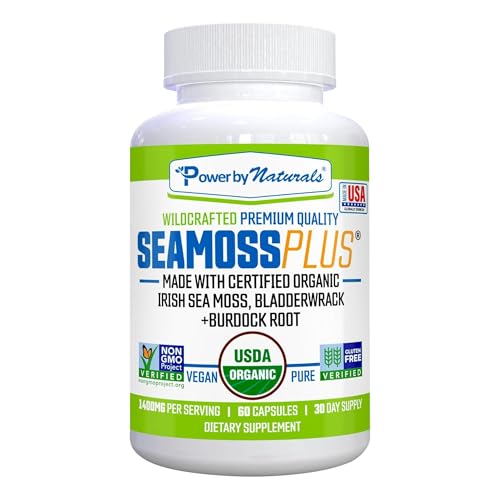
Start with species. Sea moss is Chondrus crispus. Bladderwrack is Fucus vesiculosus, a brown seaweed with a substantially higher and more variable iodine content, and it is frequently blended into products sold as sea moss. A blend is not automatically a worse product, but it does mean that any iodine figure on the label is a combined one.
Then look at how the serving is broken out. A label stating each ingredient separately, for example so many milligrams of sea moss and so many of bladderwrack, lets you compare bottles and track intake. A single proprietary blend total does not, because the ratio between the species is undisclosed and the iodine contribution is therefore unknowable.
Finally, check whether iodine appears as its own line in micrograms. Plant weight in milligrams is not a dose of anything in particular. Iodine in micrograms is, and it is the figure you would compare against an upper intake level or discuss with a clinician.
What a Certificate of Analysis Should Actually Show
A useful Certificate of Analysis is specific and boring. It names the laboratory that performed the testing. It carries a batch or lot number you can match to the bottle you bought, rather than a generic company wide document. It is dated, and the date falls within the shelf life of that batch.
On results, it reports numbers rather than pass or fail language: lead, arsenic, cadmium and mercury each with a measured value and a unit, ideally with arsenic separated into total and inorganic, given how much of seaweed arsenic is the organic form[4]. It should also state iodine content, because that is the parameter most likely to affect you and the one most often missing[2][3].
What does not count: a seal or badge with no underlying document, the phrase third party tested with no report available, a report with the batch number redacted, or a purity percentage with no analyte named. Ask the brand for the batch report. A company that tests routinely can produce one quickly.
Carrageenan, Gel, and the Processing Question
Sea moss gels because of carrageenan, a family of sulfated polysaccharides characteristic of red seaweeds. Carrageenan gives the gel its texture and behaves in the diet as a soluble fibre rather than an absorbed nutrient. It is also the component that attracts the most argument.
A 2026 comprehensive review sets out the state of that argument fairly: some studies report antioxidant, antiviral, antitumour and immunomodulatory effects, others suggest impaired glucose metabolism, intestinal inflammation and immune dysregulation, and the effects appear to depend on carrageenan type, molecular weight, purity, dose and host factors. Regulatory bodies including the FDA and EFSA generally consider it safe, with concerns remaining around infant formula and long term exposure, and the review concludes that carrageenan cannot be uniformly classified as beneficial or harmful[6].
For a buyer, the honest position is that this is unresolved rather than dangerous, and that it should not displace iodine and heavy metals as the things you actually check. On nutrition, a comparative analysis of red and brown seaweeds found Chondrus crispus to be the richest of the species tested in calcium, iron, manganese and zinc, and high in amino acids[7], which supports treating sea moss as a mineral contributing food rather than as a therapy.
A Note on the Evidence
Most of what is claimed for sea moss online outruns what has been measured. The nutritional composition work is real[7], the iodine content and labelling problems are documented[2][3][1], and the contamination question has been surveyed[4]. Clinical trials testing sea moss itself against a placebo for the outcomes it is marketed for, such as immunity, energy, skin or weight, are largely absent.
That absence is the reason this guide is about product quality rather than about benefits. Choosing a well characterised, tested product is a decision you can make on evidence today. Deciding whether sea moss will do a specific thing for you is not, and any page telling you otherwise is ahead of the literature.
Frequently Asked Questions
How much iodine is in a sea moss product?
There is no single answer, and that is the core problem. Measured iodine in red seaweeds including Chondrus crispus averages a few milligrams per kilogram of dry weight with wide sample to sample spread[1], and a survey of 96 commercial macroalgae products found supplement doses ranging from 5 to 5,600 micrograms of iodine per daily dose[2]. Treat any product that does not state iodine in micrograms as an unknown dose.
Does a wildcrafted label mean the product is safer?
No. Wildcrafted describes where the seaweed was gathered, not whether it was tested. Seaweed concentrates elements from the water it grows in, and a survey of 25 edible seaweeds found total arsenic varying by more than an order of magnitude between species and origins[4]. A batch specific lab report is evidence; a wildcrafted claim is not.
What should a Certificate of Analysis actually show?
It should name the testing laboratory, carry a batch or lot number that matches the bottle in your hand, give a date within the shelf life of that batch, and report numeric results for lead, arsenic, cadmium and mercury alongside iodine content. A badge, a seal, or the word purity with no numbers behind it is marketing, not analysis.
Is sea moss gel safer than capsules?
Neither form is inherently safer. Form changes convenience and shelf life, not the iodine or heavy metal content of the seaweed that went into it. A tested capsule is a better risk profile than an untested gel, and an untested capsule is no better than an untested gel.
Should I take sea moss if I have a thyroid condition?
Ask your doctor first rather than choosing a dose yourself. Iodine drives thyroid hormone production, and chronic excess iodine intake is associated with autoimmune thyroiditis in susceptible people[8]. Products that blend sea moss with bladderwrack raise the iodine load further, and cases of thyroid dysfunction following high iodine seaweed intake are documented in the clinical literature.
Is the carrageenan in sea moss a problem?
Food grade carrageenan is generally regarded as acceptable by the FDA and EFSA, though a 2026 review notes the evidence is genuinely mixed and depends on carrageenan type, molecular weight, purity and dose, and concludes it cannot be classified as uniformly beneficial or uniformly harmful[6]. That is an open question rather than a settled danger, and it is separate from iodine and heavy metals.
This article is informational and is not medical advice. Sea moss and bladderwrack supplements are not standardised, iodine content and heavy metal levels vary by product and harvest source, and these statements have not been evaluated by the Food and Drug Administration. Sea moss is a food and dietary supplement, not a treatment, and is not intended to diagnose, treat, cure or prevent any disease. Talk with a healthcare provider before starting sea moss, particularly if you have a thyroid condition, are pregnant or breastfeeding, or take prescription medication.
References
- Risk assessment of iodine intake from the consumption of red seaweeds (Palmaria palmata and Chondrus crispus). Environmental Science and Pollution Research (2020). PMID 32803579
- Commercially available kelp and seaweed products: valuable iodine source or risk of excess intake?. Food & Nutrition Research (2021). PMID 33889064
- Emergence of Seaweed and Seaweed-Containing Foods in the UK: Focus on Labeling, Iodine Content, Toxicity and Nutrition. Foods (2015). PMID 28231201
- Survey of arsenic content in edible seaweeds and their health risk assessment. Food and Chemical Toxicology (2024). PMID 38499235
- Case report: potential arsenic toxicosis secondary to herbal kelp supplement. Environmental Health Perspectives (2007). PMID 17450231
- Carrageenan: Food Additive or Health Concern? A Comprehensive Review. Annals of Nutrition and Metabolism (2026). PMID 42560937
- Seaweed Nutritional Value and Bioactive Properties: Insights from Ascophyllum nodosum, Palmaria palmata, and Chondrus crispus. Life (2024). PMID 39598320
- Multiple Nutritional Factors and the Risk of Hashimoto Thyroiditis. Thyroid (2017). PMID 28290237
These statements have not been evaluated by the Food and Drug Administration. This information is not intended to diagnose, treat, cure, or prevent any disease. Content is for informational purposes only and is not medical advice; consult a qualified healthcare provider before starting any supplement. As an Amazon Associate we earn from qualifying purchases.
