The claim that sea moss contains “92 minerals” has become a staple of wellness marketing, but the scientific literature paints a more nuanced picture. While red seaweeds like Chondrus crispus do accumulate a wide range of elements from seawater, the number, concentration, and bioavailability of those minerals vary dramatically based on harvest location, season, and processing methods.
This article reviews the available analytical data on sea moss mineral content, highlights the specific findings on iodine and heavy metal accumulation, and explains why bioavailability—the fraction your body can actually use—remains a critical evidence gap. All research findings cited below come from peer-reviewed studies on edible red seaweeds and iodine nutrition.
Key Takeaways
- The “92 minerals” claim is a marketing simplification not supported by analytical data; actual mineral profiles vary widely by species, location, and season.
- Iodine is the only mineral with consistent human absorption data from seaweed, and its content can easily exceed safe limits in bladderwrack-heavy blends.
- Red seaweeds bioaccumulate both essential and toxic elements; arsenic, lead, and cadmium are regularly detected and sometimes exceed food safety thresholds.
- Bioavailability of most sea moss minerals in humans is unstudied; the polysaccharide matrix effects are unknown.
- Third-party batch testing for iodine and heavy metals is the only reliable way to assess product safety and consistency.
The "92 Minerals" Claim: Origin vs. Evidence
The “92 minerals” figure appears to originate from a misinterpretation of the number of naturally occurring elements in the periodic table, not from a specific analysis of Chondrus crispus. No peer-reviewed study has catalogued 92 distinct minerals in sea moss at nutritionally relevant levels. Instead, research on edible red seaweeds (Rhodophyta) shows that mineral profiles are highly variable and include both essential trace elements and non-essential or toxic metals [1]. The same study emphasizes that risk assessment for consumers must account for this variability rather than relying on a fixed mineral count.
What Analytical Studies Actually Show: Mineral Variability and Contaminants
ICP-MS validated analyses of selected red and green seaweeds confirm that metal bioaccumulation levels differ significantly between species and collection sites [2]. Essential minerals such as magnesium, calcium, and potassium are present, but so are arsenic, lead, cadmium, and mercury, with concentrations sometimes exceeding regulatory limits for food safety. The study underscores that health risk assessments based on estimated daily intake are necessary because “natural” does not automatically mean safe or consistent.

A complementary risk assessment of trace element bioaccumulation in edible red seaweeds found that the same species can show wide ranges in essential and toxic element content depending on environmental conditions [1]. This variability means that a single batch analysis cannot represent the entire category, and routine monitoring is essential for any product making mineral-density claims.
Iodine: The Most Studied Mineral in Seaweed
Iodine is the mineral most consistently quantified in seaweeds, and its concentration in bladderwrack (Fucus vesiculosus) and other brown algae can be extremely high—often exceeding the tolerable upper intake level in a single serving [3]. While red seaweeds like Chondrus crispus generally contain less iodine than brown kelps, levels still vary by orders of magnitude depending on geography and season. The same review notes that iodine absorption from seaweed matrices is efficient in humans, which makes both deficiency correction and excess toxicity plausible outcomes depending on the product and the consumer’s thyroid status.
The Arctic population data referenced in the review illustrate how habitual high seaweed intake can sustain iodine nutrition but also push populations toward excessive intake, reinforcing that “more” is not inherently better [3]. For commercial blends that combine red and brown seaweeds, the iodine contribution becomes even less predictable without batch-specific testing.
Heavy Metal Bioaccumulation and Safety Concerns
Seaweeds are well-documented bioaccumulators of environmental contaminants, including heavy metals and even engineered nanoparticles [4]. Although the nanoparticle study focused on silver, the mechanism illustrates how seaweed cell walls bind diverse elements from surrounding water. A risk assessment of edible red seaweeds found that inorganic arsenic—a known carcinogen—can constitute a substantial fraction of total arsenic, and that regular consumption of untested wildcrafted material may pose cumulative exposure risks [1].

Interestingly, selenium-enriched seaweed has shown protective effects against heavy metal toxicity in animal models, suggesting that the selenium-to-mercury molar ratio in the product may influence net risk [5]. However, this finding comes from a controlled animal study using enriched Gracilaria lemaneiformis, not from human trials with commercial Chondrus crispus products, and should not be extrapolated to untested supplements.
Bioavailability: What We Know and Don't Know
Bioavailability—the proportion of an ingested mineral that reaches systemic circulation—has been studied primarily for iodine in seaweed, where absorption appears high [3]. For other minerals in sea moss (e.g., iron, zinc, magnesium), human data are virtually absent. The polysaccharide matrix (carrageenan, fucoidan) may hinder or enhance mineral release during digestion, but this has not been quantified in controlled trials.
Without standardized extracts and human pharmacokinetic studies, claims about superior bioavailability compared to other food sources remain speculative. The structural complexity of seaweed cell walls and the presence of binding compounds like alginates and carrageenans mean that total mineral content on a label does not equate to absorbed mineral dose.
Practical Implications for Consumers
Given the wide variability in mineral and contaminant content, third-party testing certificates (certificates of analysis) for each batch are more meaningful than marketing claims about mineral counts. Consumers with thyroid conditions, those taking levothyroxine, pregnant individuals, and anyone with high seaweed intake from other sources should be especially cautious about iodine excess.
Choosing products from monitored aquaculture rather than unregulated wild harvest can reduce heavy metal exposure, but even farmed seaweed requires routine testing because water quality and seasonal changes affect bioaccumulation [2]. Transparency about harvest location, species verification, and per-batch heavy metal and iodine results should be the minimum standard for any sea moss supplement.
🛒 Where to Buy Sea Moss & Bladderwrack
- CleanseParasites Intra-Cellular Superfood Editor’s Pick
Contains sea moss and bladderwrack alongside black cumin seed and other superfood ingredients. - American Standard Supplements Organic Sea Moss, Bladderwrack & Burdock Root CapsulesLab-tested / studied
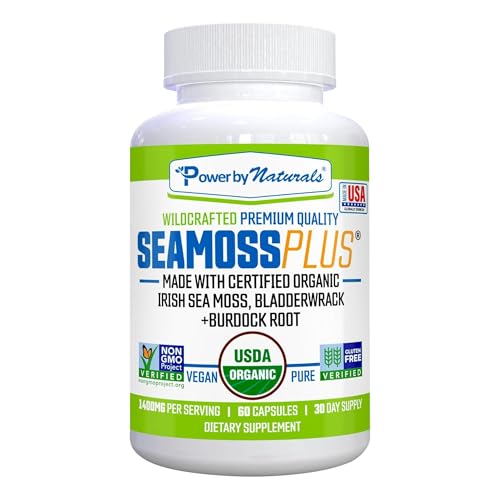
capsules, 1200mg sea moss / 1200mg bladderwrack / 225mg burdock root per serving, 120 capsules — High-dose transparent-label blend, vegan, non-GMO, made in USA; clearly stated per-ingredient milligrams rather than a proprietary blend - Secret Element Sea Moss Capsules with Burdock Root, Bladderwrack & Muira Puama
capsules, 120 capsules — Budget-friendly 4-ingredient blend, non-GMO, gluten-free, made in USA - Nutrivein Organic Sea Moss 1600mg with Bladderwrack & Burdock
capsules, 1600mg sea moss per serving plus bladderwrack and burdock — Widely available mid-tier brand, marketed for immune/digestive/thyroid/skin support claims
As an Amazon Associate we earn from qualifying purchases. Quality varies widely — always choose a product with a published third-party test (COA) before buying.

A Note on the Evidence
This article summarizes limited analytical and nutritional research on edible red seaweeds; human clinical data on sea moss specifically are sparse. Iodine excess and heavy metal contamination are documented risks. Consult a healthcare professional before using sea moss supplements, especially if you have a thyroid condition, are pregnant, or take thyroid medication.
Frequently Asked Questions
Does sea moss really contain 92 minerals?
No peer-reviewed analysis has identified 92 distinct minerals in Chondrus crispus at nutritionally relevant levels. The figure likely stems from a misreading of the periodic table. Studies show mineral profiles are variable and include both essential and toxic elements [1].
How much iodine is in sea moss?
Iodine content varies by orders of magnitude depending on species, harvest site, and season. Red seaweeds generally contain less iodine than brown kelps, but a single serving can still exceed the tolerable upper intake level for some individuals [3].
Are the minerals in sea moss bioavailable?
Human bioavailability data exist mainly for iodine, which is efficiently absorbed from seaweed [3]. For other minerals (iron, zinc, magnesium), controlled human studies are lacking, and the effect of the seaweed polysaccharide matrix on mineral release is unknown.

Is wildcrafted sea moss safer than farmed?
Not necessarily. Wildcrafted sea moss from unmonitored waters carries higher risk of heavy metal contamination (arsenic, lead, cadmium) because seaweeds bioaccumulate pollutants from their environment [1][2]. Farmed seaweed in controlled waters with routine testing offers more consistency.
Can sea moss cause heavy metal toxicity?
Regular consumption of untested seaweed may lead to cumulative exposure to inorganic arsenic, lead, and cadmium, which have been detected at levels of concern in some red seaweed samples [1][2]. Risk depends on harvest water quality, species, and consumption frequency.
Should people with thyroid conditions avoid sea moss?
Yes, caution is warranted. The high and variable iodine content—especially in blends containing bladderwrack—can trigger or worsen thyroid dysfunction in susceptible individuals, including those on levothyroxine or with autoimmune thyroid disease [3].
References
- Hossain MS et al. Trace element bioaccumulation in edible red seaweeds (Rhodophyta): A risk assessment for consumers. Environmental pollution (Barking, Essex : 1987) (2022). PMID 35654256
- Pasumpon N et al. Bioaccumulation level of metals and health risk assessment of selected red and green seaweeds validated by ICP-MS. Environmental science and pollution research international (2023). PMID 37186189
- Andersen S et al. Iodine in Edible Seaweed, Its Absorption, Dietary Use, and Relation to Iodine Nutrition in Arctic People. Journal of medicinal food (2019). PMID 30990756
- Quarato M et al. Bioaccumulation, biodistribution, and transformation of polyvinylpyrrolidone-coated silver nanoparticles in edible seaweeds. The Science of the total environment (2024). PMID 39069189
- Luo H et al. Protection of Siganus oramin, rabbitfish, from heavy metal toxicity by the selenium-enriched seaweed Gracilaria lemaneiformis. Ecotoxicology and environmental safety (2020). PMID 32890922
These statements have not been evaluated by the Food and Drug Administration. This information is not intended to diagnose, treat, cure, or prevent any disease. Content is for informational purposes only and is not medical advice; consult a qualified healthcare provider before starting any supplement. As an Amazon Associate we earn from qualifying purchases.
